Tuesday, June 3, 2014

A Poem for the Impossible Journey


When God calls us to a difficult journey, we sometimes despair that we cannot make it. God, of course, knows that.

He has already made provision for us to do the impossible.


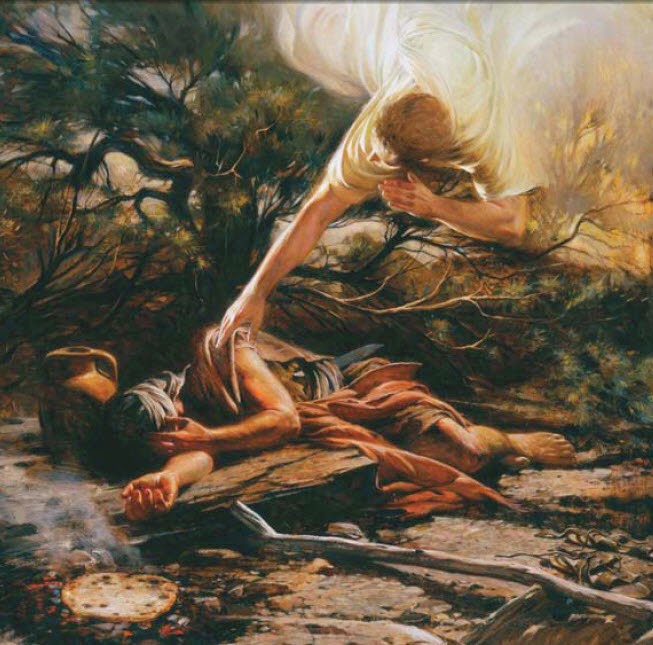
Such is the case with a story I have always loved-- the story of Elijah after he has had a spiritual victory over the prophets of Baal, has seen the miracle of fire from heaven, and the miracle of rain after a three year drought. He is afraid and in despair and falls asleep.  


Two times an angel visits him, touches him, saying, "Arise and eat, for the journey is too great for you," provides him with a cake on hot stones and a jar of water, and then lets him sleep again. Elijah was able to go forty days and forty nights in the strength of that food until he arrived at the mount of God. (Often in Scripture the mountain is the place of miraculous provision).  


I wrote this poem for my husband when he became a bishop, as I knew it would require supernatural provision. Now I submit it to all of you who are on a journey that requires food from heaven just for you to make it one more day. May you know that God is giving himself to you. Go to the mountain of the Lord, for "on the mountain of the Lord, it will be provided."


Arise and Eat


Arise and eat
for the journey is too great for you.
You are only made of atoms
and mountains will have to move.
Water will need to come from stone,
and you will have to live on more than bread.


Arise and eat
for the journey is too great for you.
I have food you know nothing of.
This food is mine prepared for you
by angels at the hearth of heaven.
This, my hand, will feed you.


Arise and eat
for the journey is too great for you.
Your prayers cry out for ancient fire,
but it is living and will singe your skin.
This is my hand, made pure by fire,
and I baptize you with it.


Arise and eat
for the journey is too great for you.
Those who have not bowed to Baal
must be gathered for the approaching reign.
This, my hand, that gathers oceans
in a water-skin will discharge the waters.


Arise and go.
Lift your robes and run.
Do not fear the evil charging at your back.
I will meet you on the mountain of miracles
where all will be afforded.
This, my right hand, is yours.


--Katherine Ruch


Friday, May 9, 2014

Living in Vertical Time


The Narnia Chronicles by C.S. Lewis open in all of us, even as adults, that mysterious longing for a world beyond this one in which we live our daily lives.  How we long to step into a wardrobe and discover a world where our responsibilities are different, and we have a community so much larger than the one in which we currently transact our business--a community populated with all sorts beyond our imagination.  It is a place where good ultimately wins, and the King comes and saves the day.

What C.S. Lewis is giving us in Narnia is an intuition of the Real.  Our lives lived in such a small frame, limited by our clouded and sophisticated vision, could and should expand into a broad space that is not fictional, but real.  The REAL world we live in with God is much more expansive than our imaginations could ever fathom, but most of the time our world seems, instead, constricted and binding.

How do we get to that expansive place in our minds and hearts, in which our REAL LIFE encompasses what we see but also what we do not see (that is just as real)?  I believe this requires a training of the inner vision, practicing the presence of the Unseen Real.  Every time we enter into worship of truth and spirit, we align ourselves with that reality larger than ourselves that stretches us beyond our tiny existence.

We have just walked through Holy Week.  In our journey with Christ as a Church, we experience the filling of time with eternal space.  Our normal experience of time, as a created being, stretches for us in a linear way.  When we come into worship, God lets us experience the stretching and filling of time in a vertical way.  The grief in the Garden, the cross, the resurrection, come present to us in our immediate experience of time.  We are in time outside of time.

Our church has many Holy Week services: Maundy Thursday, Good Friday Stations of the Cross, Good Friday Evening Service, Easter Vigil, and Easter Day. Since my husband is the priest leading most of these services, I arrive with my six children, exhausted, dragging in snacks, diaper and wipes,  water bottles, carrying the remains in my heart of what it took to get out the door: "What do you mean you still have to comb your hair?" "Put your coat back on."  "Where is his other shoe??!!" "Turn off the lights, please." "Where is____?" "Who let him out in the garden? Now he is all dirty." I apologize all the way to church for my impatience and harshness.  I am weary, and am prepared to face a service in which my youngest will be quiet, but crawl all over me, need to be kept busy, and different children will go and come with their different responsibilities...choir, acolyting, etc.

But as I quiet myself and enter into the presence of God, I find my time intersecting with another time that infuses meaning into this time.  I see my children washing each other's feet at Maunday Thursday;  I see them at the cross praying; I see them dancing at the Vigil and singing with such abandon.  I can bring them here where time in God's kingdom intersects with ours;  and we can be drawn out of our petty concerns into the vastness of freedom and release in God. This is the reality that will ultimately be my full reality.  For now, however, I live learning to find inner highways to Zion, God's dwelling. (Ps. 84, "Blessed are those...in whose heart are the highways to Zion.")

The cross is the ultimate meeting of eternal time with chronological time...the horizontal meeting the vertical.  God who created time, comes into time and sacrifices himself--a sacrifice that saves both those before the cross and after. It operates back in time.  His resurrection is also this divine intersection, visiting even those who had died before with his living presence.  The cross and the resurrection create a bridge for us between our current time lived out on this earth, making a way for us into the eternal time of God.  Literally, Jesus, in his body, makes it possible for us to reach outside of our finite time.

It is beautiful to be expanded in this way because we can become so small in our existence, living without awareness of the vastness of the life to which we belong and that we have been so freely given: Eternal Life...not just eternal in its horizontal direction, but eternal in its vertical direction.  In other words, at any moment we can enter into a vertical experience of time that takes us into God's presence, that unbounded by time, moves in and outside of our time.

If God could condense his vastness into a small baby, can he not take us, in our smallness, into his vastness, expanding us into his depths and heights? As we receive his presence, we receive a world that needs new eyes, new ears, new perceptiveness, indeed, a new heart and spirit to be able to engage it.  These eyes and ears that we have are not accustomed to seeing beyond our cramped spaces.

Training our imaginations and spirits to see and know the kingdom of God in the now of our lives is a lifetime journey.  And we only embark on it one step at a time.  The first step is to stop and be in the moment God has created and ask him to infuse it with his kingdom.  He walks through walls and the limits of minutes, for he owns all space and time.  And if we so desire, he will take us to his kingdom, or better said...will bring it to us right where we are.  "The kingdom of God is near."
Friday, April 25, 2014

In Need of a Resurrection

Though I wrote this poem for the occasion of the consecration of our new church building (our church name is Church of the Resurrection), I thought I would post this in the Easter season, as it expresses our need for the ultimate resurrection power of Jesus in our daily lives. I hope it blesses you, as you walk in the death and resurrection everyday. The icon depicted in this picture is painted on canvas by three artists in our church. It is shown here at our Easter Vigil service in 2013, not in our own church building.


Coming to our Resurrection

To be given the right walls
and doors whose hinges open--
To find an ancient floor
and the right place to fall--
Is that not why you and I
first came to this Resurrection?


We came like Lazarus, bound
but staggering in the right direction.
We came like so many Shunamite women,
undone, bearing our lifeless sons,
crying out for a resurrection.


We were waiting for the Word
to hover over our emptiness
speaking, “Let there be!”—the wind
to drive a dry way through
our restless waters ---the breath
to rustle over our dry bones
with the rush of a resurrection.


And here we are alive,  
standing on bare feet.
We found our pains were windows,
our crosses a place to rise.
But like Jairus’ girl—Jesus, lift us up.
Our hands are feeble;  we are hungry
and are here for food.
Please raise us up for this
must be our Resurrection.
  --Katherine Ruch, 2013

Monday, April 7, 2014

Book Flash: THE ORPHAN MASTER'S SON by Adam Johnson

In keeping with my intentions to extol good story, I will try to recommend books on a somewhat regular basis.  This is my favorite fiction of the year:


The Orphan Master's Son by Adam Johnson

This book is set in North Korea and has as its main character Jun Do (John Doe--your Everyman).  Jun Do is a puppet of the state, taking up any role assigned him, including horrible kidnappings.  At some point, he desires to assert his own personhood and begins to love, which eventually leads to sacrifice that costs him everything.  That is, however, what finally makes him a true man rather than a shadow of one.  This book is beautifully written and haunting.

The author much deserved the Pulitzer Prize he won for this book, and you can find interviews with him that elucidate his extensive research for this book, and why he chose the genre of fiction.  Here is one of his comments:

"If literature is a fiction that tells a deeper truth, I feel my book is a very accurate portrayal of how the tenets of totalitarianism eat away at the things that make us human:  freedom, art, choice, identity, expression, love."

This book paints a horrifying picture of North Korea--a country for which we have little information.  The reader should be warned that this book is raw when it comes to its details about tortures and descriptions about the labor camps.  Johnson stated in an interview that he had to soften some of the facts because the truths were so much worse.  The narrative of the State that is piped in via loudspeaker to every home is the story that defines and shapes persons and ultimately dismantles family, friendship, and community of any kind, challenging any loyalty other than the loyalty to the Dear Leader--Kim Jong Il (the Orphan Master?)  Some good humor emerges in the diplomatic trip that Jun Do and the other emissaries take to America, in which they are hosted at a Texas Ranch.  This only serves to highlight the disconnection that North Korea has from the rest of the world and perhaps how little the rest of the world understands their insular culture.

I was deeply moved by this book.   I have been interested in North Korea partly because it is the most violent and aggressive government in its persecution of Christians. To see how a people can become complicit with the dismantling of their own culture, community, and personhood by submission to a manipulative narrative that defines reality for them, was like a warning to all of us in the free world.  To see, then, the power of the choice to turn away from that narrative and try to discern truth and live in love was powerful.  In the end,  self-sacrifice was the greatest emancipation.  Johnson's scope spans a culture and country but also the inner workings of a human heart.

.